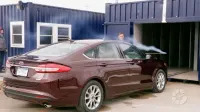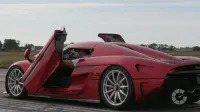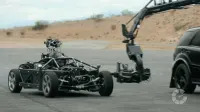
Conceived as a catalyst for change, the Progressive Automotive X Prize is an event engineers dream of and dreamers engineer to win. At stake is a share of a $10 million purse and the opportunity to impact the world. Announced in March 2008, the backers of the X Prize hoped their significant purse would speed the development of more efficient automotive transportation. How efficient? How about at least 100 mpg?
Understanding The Challenge
While 100 mpg sounds good, the composition of the X Prize's competitors made measuring economy tricky. Many competitors used electric motors, so organizers came up with a complex formula to calculate an equivalent measurement that calibrated energy consumption in mpg-e, with the "e" standing for equivalent. The mpg-e figure - discussed in this blog post - allowed all vehicles to compete (or consume) on a level playing field.
Competitors drove into two categories. Mainstream Class entries seat four, have four wheels, and a driving range of at least 200 miles before refueling or recharging is required. Alternative Class entries are subject to fewer requirements and need to have only two seats and a 100-mile range. The $10 million purse gets split between the two classes, with $5 million going to the winner of the Mainstream Class, and the other $5 million getting split between the top two finishers in the Alternative Class.
Propulsion systems for both classes were wide open. The initial round included vehicles with nearly every imaginable power source including units powered by batteries, hybrid systems, diesel, bio-diesel, gasoline, compressed natural gas and ethanol.
The X Prize Competition Hits The Track
AOL Autos has followed the X Prize competition for nearly a year. Earlier this summer the organization's Race Director, Bob Larsen, told AOL about the progress teams were making, "We're seeing efficiency way, way over our initial goal of 100 mpg. Some teams are hitting 150 mpg with vehicles that are passing all the dynamic testing. The performance we're seeing here is really impressive."
The X Prize competition wrapped up its final round of competitive testing at Michigan International Speedway (MIS) late in July. The third round increased the efficiency threshold to 90 mpg equivalent, up from 67 mpg-e. Fuel efficiency testing included three driving loops that attempted to mimic neighborhood, urban/suburban, and highway driving styles. Adding to the stress were 0-60 mph acceleration tests, 60-0 mph braking tests, and a 45-mph double-lane change accident avoidance maneuvers.
The temperatures were as hot as the competition at the July MIS event. The acceleration runs were of crucial importance because the fastest vehicle to 60 mph that also achieved 100 mpg-e would be crowned the winner of the X Prize.
The dynamic events took their toll on certain teams. The valiant college team from Western Washington University got knocked out because their main driver was sidelined with a broken arm. The team's less-experienced backup driver wasn't able to successfully complete the 45-mph emergency lane maneuver in the Viking 45. X-Prize Race Director Bob Larsen said, "The Viking 45 was on its way to the finals because it had met the efficiency goals. This is a real heartbreaker, but the team took the loss with great maturity."
But the young college students weren't the only ones sidelined at MIS. The well-funded, professional effort from India's Tata Motors ran into technical difficulties at MIS and had to withdraw. Gremlins in their vehicle's charging system could not be exorcised, ending the competition for the serious contender.
The winning teams who earned their shot at $10 million were; Aptera, Edison2 (two vehicles), Li-ion Motors, RaceAbout Association, TW4XP, X-Tracer Team Switzerland (two vehicles), and Zap. These nine remaining vehicles went on to Argonne National Laboratories in Chicago for specialized testing to determine each vehicle's ultimate fuel-sipping capabilities.
The $10 Million Goes To...
After extensive economy testing, three teams drove away from the competition loaded with a bronze trophy and seven-digit checks. Edison2 of Lynchburg, Virginia, was awarded $5 million. X-Tracer of Winterthur, Switzerland, took home $2.5 million, and Li-ion Motors Corp. of Mooresville, North Carolina, pocketed a further 2.5 million.
The dramatically styled four-seat car from Edison2 achieved 102.5 mpg-e running on E85 ethanol. The teardrop-bodied car boasted the lowest drag coefficient of any four-wheeled vehicle in the X Prize competition. Weighing only 830 pounds, the creation earned its name "Very Light Car." This vehicle weighs less than half of the tiny Lotus Elise, one of the lightest production cars available in the U.S.
Powered by lithium-ion batteries, the two-seat Li-ion Motors "Wave II" achieved a stunning 187 mpg-e. While the vehicle used a lightweight aluminum chassis, it still weighed nearly 2,200 pounds due to the weight of its batteries. Testing demonstrated that the Wave II was capable of driving more than 100 miles in real-world conditions, and could accelerate from 0-60 mph in 14.7 seconds (about twice the time required for an average vehicle).
Topping the economy portion of the competition was the tandem two-seat E-Tracer from Switzerland. The fully electric vehicle achieved 205.3 mpg-e. Fitted with batteries that delivered more than 100 miles of range, the 1,436-pound vehicle was capable of accelerating 0-60 in a sporty 6.6 seconds. The chassis combined attributes of motorcycles and automobiles. At speed it runs on only two wheels, and deploys extra outrigger wheels at low speeds for stability.
What Now?
With $10 million in prize money awarded, the real-world competition is just beginning. Even though the winning teams have accomplished much, the bigger challenge will be whether these X Prize champions can compete and win in the free market.
To help aid future progress, the winning manufacturers can now tap available development programs funded by U.S. Department of Energy.
X Prize Foundation Chairman Diamandis said at the award ceremony, "We've seen a shift in the market since we first launched this competition, and a greater awareness by people everywhere to think more seriously about the actions we take, and how they affect our environment. I believe strongly that the innovations showcased throughout this competition will continue to impact and improve our car buying options for the future."
Time will tell.


15 Comments